
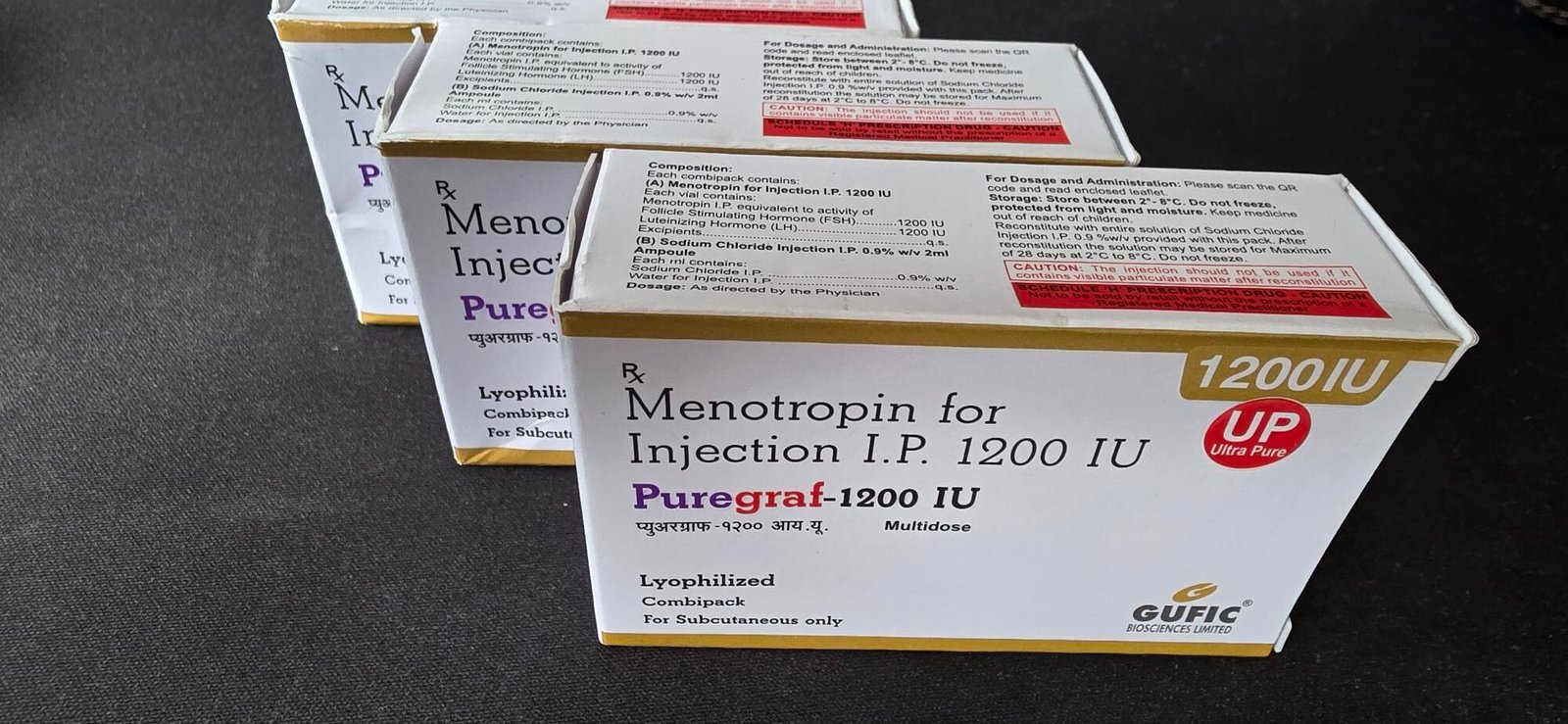
HMG (Menotropin) 1200 IU — Fertility, Spermatogenesis & Reproductive Hormone Research
Human Menopausal Gonadotropin (HMG) | FSH & LH Activity | Male and Female Reproductive Endocrinology
Product Overview
Human Menopausal Gonadotropin (HMG), also known as Menotropin or Menotrophin, is a gonadotropin preparation containing follicle-stimulating hormone (FSH) activity and luteinising hormone (LH) activity.
These hormones play essential roles in regulating reproductive function in both males and females.
In men, HMG is particularly important in the study and clinical management of spermatogenesis, testicular function and certain forms of infertility associated with insufficient gonadotropin stimulation.
In women, menotropin is widely used in fertility medicine to stimulate ovarian follicular development and support assisted reproductive treatment.
HMG is also of considerable interest in reproductive endocrinology because of its relationship with testosterone production, testicular function and fertility preservation during testosterone replacement therapy (TRT).
How HMG Works
The reproductive system is regulated by the hypothalamic-pituitary-gonadal (HPG) axis.
Under normal physiological conditions, the hypothalamus releases gonadotropin-releasing hormone (GnRH), stimulating the pituitary gland to release two important hormones:
Follicle-Stimulating Hormone (FSH)
FSH acts directly on the Sertoli cells within the seminiferous tubules of the testes. These cells provide structural, metabolic and biochemical support for developing sperm cells.
FSH signalling contributes to:
- Initiation and maintenance of spermatogenesis
- Sertoli cell function and sperm development
- Production of proteins involved in sperm maturation
- Regulation of inhibin B secretion
- Maintenance of the seminiferous tubule environment
Luteinising Hormone (LH)
LH acts primarily on Leydig cells, which are responsible for testosterone production within the testes.
Testosterone produced locally in the testes is essential for normal sperm development.
In menotropin preparations, LH-like biological activity may be provided partly or predominantly by human chorionic gonadotropin (hCG).
Together, FSH and LH activity support the hormonal environment required for normal reproductive function.
HMG and Male Fertility
1. Stimulation of Sperm Production
One of the most significant clinical applications of menotropin is the treatment of selected forms of male infertility, particularly hypogonadotropic hypogonadism.
This condition occurs when the pituitary gland produces insufficient FSH and LH, resulting in inadequate stimulation of the testes.
Without sufficient gonadotropin activity, sperm production may be severely reduced or absent.
HMG provides FSH activity that stimulates Sertoli cells and supports the development of sperm cells.
Spermatogenesis involves several stages, including the division and differentiation of germ cells, development of spermatids and eventual formation of mature spermatozoa.
Because this process takes approximately 74 days, improvements in sperm production generally require sustained hormonal stimulation over several months.
In appropriate patients, gonadotropin therapy can improve sperm production and may restore fertility.
2. Testicular Function and Maintenance
The testes perform two distinct but closely related functions:
- Testosterone production by Leydig cells
- Sperm production within the seminiferous tubules, supported by Sertoli cells
Normal testicular function depends on appropriate stimulation of both systems.
FSH activity supports the sperm-producing compartment, while LH or hCG activity supports intratesticular testosterone production.
This distinction is particularly important when evaluating men receiving testosterone replacement therapy.
3. HMG and Testosterone Replacement Therapy (TRT)
Testosterone replacement therapy is commonly prescribed to men with clinically established testosterone deficiency.
Although TRT increases circulating testosterone concentrations, externally administered testosterone suppresses the body’s natural production of LH and FSH through negative feedback on the hypothalamic-pituitary-gonadal axis.
This suppression can have several consequences:
- Reduced intratesticular testosterone production
- Reduced Sertoli cell stimulation
- Decreased sperm production
- Reduced testicular volume
- Oligospermia (low sperm count)
- Azoospermia (absence of sperm in the ejaculate)
Importantly, normal or elevated blood testosterone levels during TRT do not necessarily indicate normal sperm production.
4. The Potential Role of HMG Alongside TRT
HMG is of particular interest in men receiving TRT who wish to maintain or restore reproductive function.
Its FSH activity provides stimulation to Sertoli cells that may be absent when endogenous gonadotropin production is suppressed.
However, FSH stimulation alone is generally insufficient for normal spermatogenesis without adequate intratesticular testosterone.
For this reason, fertility specialists may use gonadotropin-based treatment strategies involving hCG and FSH-containing preparations such as HMG.
HCG and HMG have complementary biological roles:
HCG: Primarily stimulates Leydig cells through the LH receptor, supporting intratesticular testosterone production.
HMG: Provides FSH activity to support Sertoli cell function and sperm development, alongside LH-like activity.
In selected patients, this combination may help restore the hormonal environment required for spermatogenesis.
The evidence supporting fertility preservation while continuing TRT is more limited than the evidence for specialist-managed fertility restoration after stopping exogenous testosterone. HMG should therefore not be considered a guaranteed means of maintaining fertility during TRT.
5. HMG, HCG and Spermatogenesis
HCG and HMG are frequently discussed together in male fertility medicine, but they are not interchangeable.
HCG primarily addresses the testosterone-producing function of the testes.
HMG provides the FSH stimulation necessary for the sperm-producing compartment.
In men with hypogonadotropic hypogonadism, hCG may be used to establish adequate testosterone production, with FSH-containing treatment introduced when additional stimulation of spermatogenesis is required.
Clinical responses vary according to underlying diagnosis, testicular development, previous fertility history and duration of gonadotropin deficiency.
HMG and Female Fertility
1. Ovarian Follicular Development
In women, FSH stimulates the growth and maturation of ovarian follicles.
Each follicle contains a developing oocyte surrounded by supporting granulosa cells.
Menotropin provides gonadotropin activity that can stimulate follicular development in women with certain ovulatory disorders.
2. Ovulation Induction
HMG is used clinically in selected women who do not ovulate normally.
By stimulating ovarian follicular growth, menotropin can help promote the development of a mature follicle.
Ovulation may subsequently be triggered using another hormonal treatment when appropriate.
3. Assisted Reproductive Technology (ART)
Menotropin is used in assisted reproductive procedures, including in vitro fertilisation (IVF).
Controlled ovarian stimulation encourages the development of multiple follicles, allowing several oocytes to be retrieved during a treatment cycle.
This can increase the number of eggs available for fertilisation.
4. Oestrogen Production and Follicular Maturation
FSH stimulates granulosa cell activity and aromatase expression, contributing to oestrogen synthesis.
LH activity supports androgen production by theca cells, providing substrates that granulosa cells convert into oestrogens.
Together, these hormonal pathways support follicular growth and reproductive endocrine function.
HMG Compared with HCG
| Characteristic | HMG (Menotropin) | HCG | Primary activity | FSH and LH activity | LH-like activity | Main testicular targets | Sertoli and Leydig cells | Leydig cells | Sperm production | Direct FSH-mediated support | Indirect support through testosterone | Testosterone production | Supports through LH activity | Strong LH-receptor stimulation | Male fertility applications | Selected infertility treatments | Selected infertility treatments | Female fertility applications | Follicular stimulation | Ovulation triggering |
|---|
Areas of Scientific and Clinical Interest
HMG is relevant to research involving:
- Male and female reproductive endocrinology
- Spermatogenesis and Sertoli cell signalling
- Leydig cell function and testosterone production
- Hypogonadotropic hypogonadism
- Gonadotropin suppression associated with TRT
- Testicular function and fertility restoration
- Ovarian follicular development
- Ovulation induction
- Assisted reproductive technologies
- Hypothalamic-pituitary-gonadal axis regulation
Product Information
Product Name: HMG (Menotropin / Menotrophin)
Strength: 75 IU (confirm the declared FSH and LH activity against the manufacturer’s specification)
Product Category: Gonadotropins / Reproductive Endocrinology
Biological Activity: FSH and LH activity
Research Focus: Fertility, Spermatogenesis, Ovarian Function and Hormonal Regulation
Safety and Regulatory Information
Menotropin is a biologically active medicinal substance requiring appropriate clinical oversight when used therapeutically.
In men, treatment requires evaluation of the underlying cause of infertility and monitoring of hormonal and semen parameters. Treatment may be ineffective in primary testicular failure.
In women, ovarian stimulation carries risks including ovarian hyperstimulation syndrome (OHSS), multiple pregnancy and other complications requiring specialist monitoring.
Research-use products are not intended for human or veterinary administration. Clinical uses described above refer to appropriately authorised medicinal preparations under specialist supervision.



Reviews
There are no reviews yet.